

तत्परं पुरुषख्यातेर्गुणवैतृष्ण्यम्॥१६॥
Tatparaṁ puruṣakhyāterguṇavaitṛṣṇyam
“That is the supreme dispassion which arises on account of knowledge of the Purusha, resulting in indifference toward the qualities of nature.”
What Happens After We Let Go?
In life, we tend to imagine freedom as a lack of things—no more pain, no more stress, no more craving. But what if real freedom is not about what we release. but what we know within?
In the last sutra (1.15), Patanjali presented us with Vairagya—the disattachment that arises once we start to let go of our hold on enjoyments and desires. But in Sutra 1.16, he goes a step further. He describes para vairagya, the highest disattachment—a condition not arising from effort or repression, but from profound Self-knowing.
This is the crux of Yoga Sutra 1.16.
Breakdown of the Sutra: What Does It Really Mean?
Tatparam – That which is supreme
Purusha-khyater – Through knowledge or direct experience of the Purusha (the true Self or Seer)
Guna-vaitṛṣṇyam – Indifference or desirelessness even toward the gunas, the fundamental qualities of nature (sattva, rajas, tamas)
This sutra reminds us that ultimate peace doesn’t come from mastering the world—it comes from understanding who we are beyond the world.
Knowing the Gunas: The Qualities that Inform Our Experience
All that exists in nature (Prakriti)—our bodies, minds, actions, even our dreams—is made up of three qualities or gunas:
Tamas – laziness, inertia, ignorance
Rajas – activity, desire, restlessness
Sattva – peace, clarity, balance
Many of us spiritual seekers try to cultivate more sattva, but even that is still within the grip of Prakriti—still part of nature’s play. Patanjali provokes us here: Can you transcend even that?
To know the Purusha, the witnessing self, is to become free from the push and pull of these qualities.
Purusha Khyati – Knowing the Self
What is this knowing of the Purusha?
It is not book learning or philosophical belief. It is a change of view. A knowing that emerges not from the mind, but from seeing deeply.
You are not the body.
You are not the emotions.
You are not your thoughts.
You are not even the “doer” or “knower.”
You are the one who observes all of it.
When this becomes real—not as an idea but as lived truth—then there is no longer any attachment to qualities, outcomes, identities, or roles.
That is Tatparam Vairagya.
Guruji’s Vision: Walking the Path of Inner Mastery
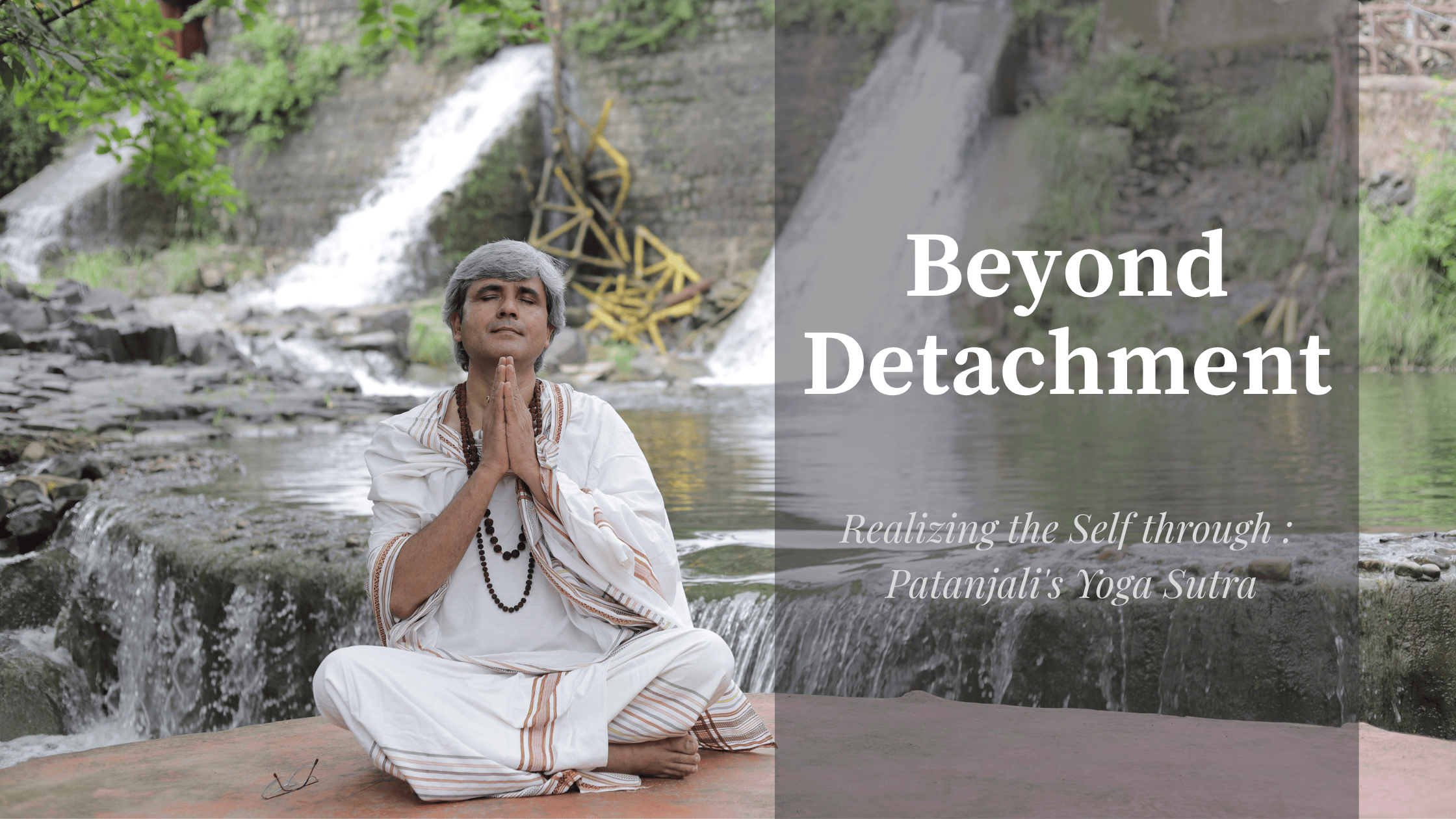
Our dearest Guruji, Dr. Radheshyam Mishra, will frequently explain this style of detachment is not rejection—it is mastery. It is the skill of being in the world, serving the world, loving fully—without being ensnared by the world.
Being a person who himself traversed the path of suffering, change, and intense Yogic training, Guruji reminds us that Self-knowledge is not escapism—it is the greatest example of presence.
“When you realize the Purusha, you don’t stop living—you start living consciously.” – Guruji
His own path—from a young seeker with asthma to a master yog trainer, certified to train more than 6,500 teachers globally—demonstrates that inner realization creates meaningful action, not inaction.
How Can We Move Towards This Supreme Detachment?
Even though we are not yet in the state of Sutra 1.16, we can ready ourselves to savor glimpses of it. How?
1. Witnessing Meditation
Watch your thoughts, breath, and emotions pass by without labeling or judging them. Ask yourself, Who is watching?
2. Self-Inquiry
Apply the Neti Neti method (not this, not this) to shed the layers of unreal identity.
3. Let Go of Even the Good
Practice letting go of attachment not only to pain, but also to pleasure, pride, spiritual ego, or self-image.
4. Satsang & Scriptural Study
Remain close to teachers and teachings that keep you mindful of the Self. Guruji’s Yog Sutra teachings and worldwide community are one such anchor.
Yogis’ & Teachers’ Reflection
Ask yourself:
Am I identifying with the traits I exhibit?
Do I cling to being ‘calm,’ ‘successful,’ or even ‘spiritual’?
Can I let go of all identities—even good ones—and simply be the witness?
The path to Purusha-khyati isn’t a path of perfection. It’s a path of deepening honesty, stillness, and presence.
Closing Thought: The Freedom You’ve Been Searching For
Patanjali isn’t indicating a life of isolation or denial. He is indicating the greatest power of freedom—the one that’s at the center of our own awareness.
Tatparam Vairagya is not indifference—it is the highest form of love. A love that is free. A love that is not bound by qualities. A love that sees clearly, acts cleanly, and rests deeply.
Explore Deeper with Us
Ready to live this philosophy?
Join Guruji’s globally recognized Teacher Training Courses, Yog Sutra Study Groups, and online workshops that bring classical yog wisdom to everyday life.
Visit: www.yogalifeglobal.com
Make the sutras not only a part of books—let them live through you.
Leave a Reply